Posts

Showing posts with the label Robots

October 1954: Comet at Twilight

Image
In Captain Comet’s final adventure of the 1950s, the fictional futuristic man faces off against a symbol of society’s actual future — the computer. Or so it seems. In The Revolt of the Thinking Machine (Strange Adventures 49, Oct. 1954) , the Man of Destiny communicates the history of what he presciently says may be his “final battle” to Prof. Zackro through the professor’s TV. As newsboys shout that a Midwest University “thinking machine” has locked out the scientists who built it, Captain Comet tells Zackro, “I got to the Physics Building, of course, only moments after the story got out…” Communicating through a typewriter, the “giant calculator” warns, “No one must interfere with what I am doing! If anyone forces his way into the room, I shall destroy him!” The Man of 100,000 A.D. does just that as the machine blasts him with electric energy. “The bolts, of course, had no effect on me!” Comet tells Zackro. “My unique body instantly set up an immunity to the p...

September 1953: Attack of the Arcade Aliens

Image
DC’s tendency to work children’s preoccupations into its stories is on display again in The Grab-Bag Planet ( Strange Adventures 36, Sept. 1953), when giant mechanical claws start grabbing up goodies on Earth as part of a treasure hunt played by bored, amoral aliens from the planet Cnossur. The reference is obviously to those glass-fronted arcade claw machines that offer tempting gimcrack prizes. They became popular in the early 20 th century, inspired by the public’s fascination with the steam shovels that excavated the Panama and Erie canals. “A hand crank on the front allowed them to make a descent into a pile of hard candy to grab a small prize,” noted Jake Rossen. “The wheel was sensitive: A wild spin could get the crane moving, while a light, radio-dial touch could zero in on a target.” “When the Great Depression hit, they became a cheap way to risk what little money people had for the chance at a child’s trinket — maybe even a dollar wrapped around a pocket knife… By t...

August 1953: If They Only Knew...

Image
One of my favorite Captain Comet stories is The Cosmic Chessboard , both because of a sly wink writer John Broome built into the tale and because the concept was echoed in a couple of Silver Age classics. As a writer, I like to retain, recycle and recast material I’ve written when it might be useful again, and DC Comics also long practiced this form of intellectual thrift. For example, compare the Murphy Anderson covers of Strange Adventures 35 ( The Cosmic Chessboard, Aug. 1953) and Justice League of America 1 ( The World of No Return, Oct-Nov. 1960). In both cases, heroes are playing a cosmic chess match that imperils real people, and both stories even feature a dinosaur fin-headed alien who sports a third eye, (one is green-skinned, the other red-skinned). That’s one easy “tell” for recognizing the hand of particular comic book artists, of course. They all tend to have distinctive types of fantasy aliens that they draw. For DC, publishing in an era in which it was exp...

February 1953: The Time Capsule Trojan Horse

Image
Captain Comet again prefigures Magnus, Robot Fighter in The Time Capsule from 1,000,000 B.C. ( Strange Adventures 29, Feb. 1953). An archeological dig in the American West has the seemingly rare good fortune of having an artifact come right to it when a stone-age time capsule drills its way to the surface. “I am Camron, chief scientist of this land one million years ago!” says a filmed warning included in the capsule. “By a telepathic radar device, my language is being translated into your own even as I speak!” The world learns that an ancient civilization was wiped out by a radioactive cloud due to return a million years later, i.e. in 1953. Newspapers carry the story of the threat to humanity with the hope that Captain Comet can stop it. “Zackro, this super-sensitive radiation counter I put together indicates a giant radioactive cloud approaching the solar system right now!” the superhero tells his friend. “I’ve got to stop that deadly cloud — somehow!” Flying into s...

August 1952: Captain Comet, Robot Fighter

Image
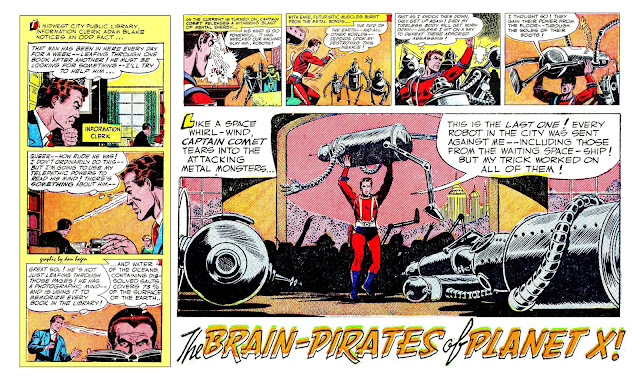
When rudely rebuffed by a library patron who is leafing through books, Adam Blake thinks, “I don’t ordinarily do this, but I’m going to use my telepathic powers to read his mind.” Blake discovers that the man is instantly memorizing every page he sees. So begins The Brain-Pirates of Planet X in Strange Adventures 23 (Aug. 1952). Tracing this mental marvel to a lonely spot in Midwest National Park, Captain Comet and Prof. Zackro find the man gathering with dozens of duplicates at a spacecraft. Secretly disabling the ship with telekinesis, Comet buys enough time to discover that, between them, these identical men have memorized all the knowledge on Earth. While the Man of Destiny tracks down the doppelgängers’ base in space, Zackro phones the Pentagon, saying, “Captain Comet wants those men held here, General — by armed force if necessary!” “If Captain Comet wants it, that’s enough for us, Professor!” the general replies. Must be nice to be Captain Co...

November 1951: The Day the Comet Still Stood

Image
In Strange Adventures 14 (Nov. 1951), in an apparent nod to the 1951 film The Day the Earth Stood Still, a gigantic spaceship hovering over Washington, D.C. (no longer called Capitol City), announces through skywriting that it intends to collect a specimen of humanity. This issue was on newsstands during the famous film's run . The groundbreaking Robert Wise film, which starred Michael Rennie and Patricia Neal, also featured a large alien spacecraft appearing over Washington, D.C., and a menacing robot. The movie premiered Sept. 28, 1951, and this issue of Strange Adventures was available on the newsstands immediately afterward, in October, during the run of the picture. So the story similarities may have been a coincidence, or — more likely — writer John Broome and editor Julius Schwartz may have prepared theirs to coincide with the film’s release. For inspiration, they could have referred to Harry Bates’ short story Farewell to the Master, which had appear...