Posts

Showing posts with the label Justice League

August 1953: If They Only Knew...

Image
One of my favorite Captain Comet stories is The Cosmic Chessboard , both because of a sly wink writer John Broome built into the tale and because the concept was echoed in a couple of Silver Age classics. As a writer, I like to retain, recycle and recast material I’ve written when it might be useful again, and DC Comics also long practiced this form of intellectual thrift. For example, compare the Murphy Anderson covers of Strange Adventures 35 ( The Cosmic Chessboard, Aug. 1953) and Justice League of America 1 ( The World of No Return, Oct-Nov. 1960). In both cases, heroes are playing a cosmic chess match that imperils real people, and both stories even feature a dinosaur fin-headed alien who sports a third eye, (one is green-skinned, the other red-skinned). That’s one easy “tell” for recognizing the hand of particular comic book artists, of course. They all tend to have distinctive types of fantasy aliens that they draw. For DC, publishing in an era in which it was exp...

June 1953: Empire of the Bees

Image
Two H.G. Wells stories helped inspire Strange Adventures 33 (June 1953). In The Human Beehive , Adam Blake travels to an irradiated South Pacific island to find tiny mammals and gigantic insects, including a super-intelligent colony of bees that has apparently enslaved the tiny human islanders. “Captain Comet is always going on journeys to other places: often planets, here an island,” observed comics historian Michael E. Grost.   “(Writer John) Broome often liked his heroes to travel. We also learn here that Captain Comet is resistant to all forms of radiation, just like Broome's Atomic Knights to come. This story is crammed with small details and little plot ideas of all kinds. Although the Captain Comet tales are short, usually six pages, Broome tried to get as much story into them as possible.” The discovery of a monstrous minnow near a nuclear test site sends Captain Comet to the South Pacific. In fact, the U.S. had detonated its first hydrogen bomb at Eniwet...

September 1952: When Earth Hated Humanity

Image
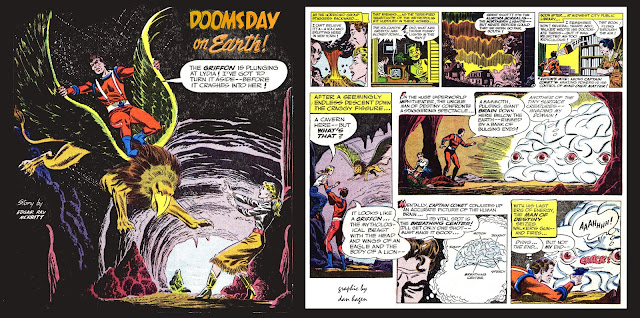
Captain Comet battles global climate change in Doomsday on Earth ( Strange Adventures 24, Sept. 1952). With the planet shaking itself apart, as volcanoes erupt in Manhattan and whirlpools swallow boats in Lake Erie, accumulated knowledge once again proves to be the key to humanity’s salvation. In the science fiction and superhero comics edited by Julius Schwartz, knowledge-based professionals invariably save the day, whether they be physicists, archeologists, pilots, forensic scientists, museum directors, lawyers, writers or — like Captain Comet — librarians. Their breadth of learning and cool level-headedness enable them to sort things out even in the face of worldwide catastrophe. Here, Adam Blake’s perfect mutant memory recalls that these events were predicted in a book in his public library. Tracing the vanished author deep into the Earth, Captain Comet tangles with a griffin, a mythological creature that has the body, tail and legs of a lion and the head, wing...

October 1951: Granite Guys and Gravity Gone

Image
In Strange Adventures 13 (Oct. 1951), Adam Blake spends his library lunch hour rocketing off to investigate stone creatures that have mysteriously appeared in Geyser Park, Wyoming (presumably Yellowstone). Titles edited by Julius Schwartz would often spotlight natural wonders like geysers, waterspouts and the aurora borealis in their stories, providing the opportunity for readers to acquire some painless scientific knowledge through footnotes. In the course of the adventure When the Earth Was Kidnapped, our planet is dragged toward the blue sun of Alpha Centauri. Gravity goes awry, causing Midwest City citizens to float into the air. Justice League of America 5 (1961) It’s the same weird phenomenon the Justice League would encounter in the Gardner Fox story When Gravity Went Wild ( Justice League of America 5, June-July 1961). Stone giants, Earth being dragged through space, gravity upended, a city beneath the Earth, alien beings rocketed back to Alpha Centauri — DC kne...

July 1951: Visions of Future Past

Image
Strange Adventures 10 finished Captain Comet's two-part origin and launched him on his first adventure. Captain Comet blazed the trail in a feature that looked much more like 1960 than 1940. The sleek elegance of Carmine Infantino’s art was emergent. It would be contemporary, clean-lined and sunlit, as optimistic and reassuring as the stories by John Broome. Infantino made the impossible seem pleasantly plausible, somehow putting the future within easy reach. “The mature Infantino drew everything — a hidden city of scientific gorillas, a harlequin committing crimes with toys, Flash strapped to a giant boomerang — as if he believed absolutely in its existence,” observed Gerard Jones and Will Jacobs in their excellent book The Comic Book Heroes. “But Infantino’s art could so fully evoke the quiet of a small-town afternoon or the cool of a shaded lawn that readers could forgive even plots full of beatniks, schoolteachers and singing idols.” The equally capable ...