Posts

Showing posts with the label Michael E. Grost

July 1954: This Objective Earth

Image
Colonial imperialism is satirized in Interplanetary War Base! ( Strange Adventures 46, July 1954). With artist Gil Kane taking over for Murphy Anderson, the story begins with one of writer John Broome’s quotidian mysteries. Rancher Jeb Hawkins awakens to find that his clock-radio and his wristwatch have stopped at six minutes after three. So has his wife’s — and it’s still dark when it should be daylight. Meanwhile, while using the excuse of rearranging the Midwest City Public Library’s newspapers, information clerk Adam Blake actually reads them all within seconds and coordinates the information in his futuristic brain. Blake correlates an article about a western “black bubble” spotted by a pilot with another about a cattle buyer who was unable to find the Hawkins’ ranch despite having visited there before — and decides that Captain Comet had better look into this. Speeding west in the Cometeer, the Man of Destiny discovers a black dome that nullifies all electronic and ...

December 1953: Sinister Simian Strikes Again

Image
Captain Comet’s version of Grodd, the “diabolically intelligent” Man-Ape, returns as a criminal defendant in The Guilty Gorilla ( Strange Adventures 39, Dec. 1953). By telepathically controlling a judge and manhandling police officers like rag dolls, the simian is able to escape and recruit a criminal gang to help him. This super-gorilla, Comet’s only recurring archenemy, foreshadows the string of early appearances by Grodd in the Silver Age Flash title. DC’s over-reliance on gorilla covers would become an affectionately mocked cliché in the late 1950s and early 1960s. The trend started in Strange Adventures . “The eighth issue of Strange Adventures achieved some sort of cult status,” noted Greg Hyland. “The cover showed a gorilla in a zoo holding up a slate that read, ‘Please believe me! I am the victim of a terrible scientific experiment!’ This Incredible Story of an Ape with a Human Brain had strong sales, and [DC editor, Julius] Schwartz recalls that (publisher) ‘Irwin...

November 1953: Comet’s Cozy Catastrophe

Image
A classic science fiction story, The Day of the Triffids , gets a wink in Strange Adventures 38 (Nov. 1953). In John Wyndham’s 1951 novel, a freak meteor shower blinds most people on Earth, unleashing a plant menace and leading to the enslavement of the few remaining sighted people. DC’s science fiction stories often had a vibe similar to the “cozy catastrophe” novels for which Wyndham became famous. Whether the author was John Wyndham or John Broome, inexplicable and weird events would suddenly intrude on everyday reality, presaging some literally earthshaking menaces that would finally be resolved by cool-headed, rational professionals. For example, when everyone in a sleepy English village literally falls asleep, all the women become pregnant with super-powered alien babies in Wyndham’s 1957 novel The Midwich Cuckoos (filmed twice as Village of the Damned ). And fireballs falling from space into the worlds’ oceans herald the arrival of unseen undersea alien invaders in Wynd...

October 1953: Fantasy with a Familiar Ring

Image
The haunting dreams of Adam Blake’s fellow librarian Lily Torrence — now renamed Lucy — provide the springboard for The Invaders from the Golden Atom ( Strange Adventures 37, Oct. 1953). Finding that an old family ring has mysteriously appeared on her finger, Torrence, while sleepwalking, constructs a device that will permit beings from an atomic world within her ring to invade Earth. But Captain Comet uses the machine to shrink himself, defeating the aliens on their home ground. Just to be on the safe side, Torrence throws the ring into the ocean from the Cometeer. Adam Blake — after figuratively giving Torrence the back of his hand for the past two years — now, bizarrely and heavy-handedly, begins to flirt. “Too bad you had to lose your gold ring,” he says coyly. “But maybe someday I — er — a lucky man will place another on your marriage finger!” Forgetting about Miss Torrence’s name and Blake’s aloof relationship to her suggests that Schwartz and Broome were beginni...

June 1953: Empire of the Bees

Image
Two H.G. Wells stories helped inspire Strange Adventures 33 (June 1953). In The Human Beehive , Adam Blake travels to an irradiated South Pacific island to find tiny mammals and gigantic insects, including a super-intelligent colony of bees that has apparently enslaved the tiny human islanders. “Captain Comet is always going on journeys to other places: often planets, here an island,” observed comics historian Michael E. Grost.   “(Writer John) Broome often liked his heroes to travel. We also learn here that Captain Comet is resistant to all forms of radiation, just like Broome's Atomic Knights to come. This story is crammed with small details and little plot ideas of all kinds. Although the Captain Comet tales are short, usually six pages, Broome tried to get as much story into them as possible.” The discovery of a monstrous minnow near a nuclear test site sends Captain Comet to the South Pacific. In fact, the U.S. had detonated its first hydrogen bomb at Eniwet...

July 1952: The Galaxy’s First Guardians

Image
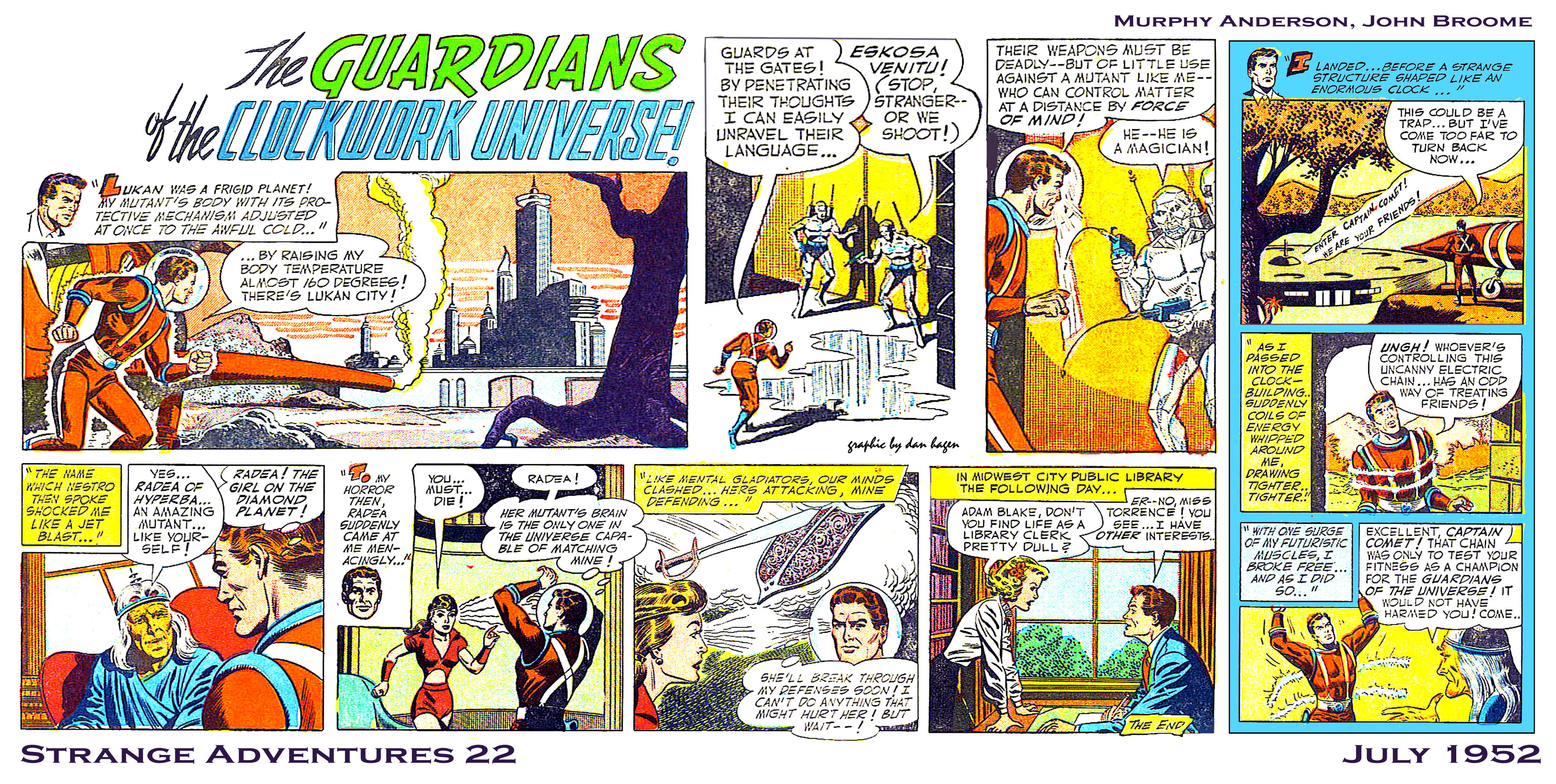
This Captain Comet adventure influenced the Silver Age revival of one of DC’s most popular superheroes. In Guardians of the Clockwork Universe ( Strange Adventures 22, July 1952), the Man of Destiny is telepathically summoned by the wizened, golden-skinned Guardians of the Universe, an ancient, advanced race working to keep planets and suns in their proper orbits. The story is framed as a flashback. When a young patron asks Midwest City public librarian Adam Blake what keeps the planets where they are, Blake replies, “Er, gravitational force,” but thinks: “That’s only part of the answer, but he’d never believe the actual truth.” He recalls that he’d been tinkering with his “private jetship” the Cometeer in its shed behind Prof. Zackro’s lab when he received a telepathic message. “The thought-beam, steady as a radio signal, led me far out into space … where, beyond the reaches of our solar system, I saw that tiny world … shining by some unearthly, sunless light.” Called to...

February 1952: Telepathy by Television

Image
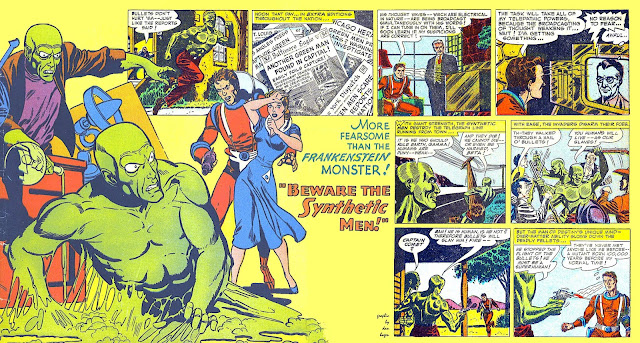
The original science fiction novel, Mary Shelley’s Frankenstein, is the explicit inspiration for Beware the Synthetic Men! in Strange Adventures 17 (Feb. 1952). Rumors of green men in Washington, D.C., prompt a televised government spokesman to brand them a myth, but Captain Comet telepathically sees through that lie. “No reason to fear,” broadcasts Dr. Stanton, the “nation’s science-defense chief” (didn’t know we had one). “Great Galaxy!” says Captain Comet. “He’s saying one thing — thinking the exact opposite!” For a mutant 100,000 years ahead of his time, Captain Comet could be remarkably naïve about politics. Or is it simply that morally and intellectually advanced beings like Adam Blake would necessarily see the ultimate futility of lying? “What’s most interesting about this tale is the use of television,” observed comics historian Michael E. Grost. “One of Captain Comet’s seemingly endless powers is the ability to read thoughts. After all, he explains that thought...