Posts

Showing posts with the label Superman

March 1986: When Men of Tomorrow Meet…

Image
Given that Captain Comet was a 1950s makeover of the 1930s Superman concept, emphasizing the mental more than the physical, it’s not surprising that the two might meet. But it was a long time coming — 29 years, in fact ( DC Comics Presents 22, June 1980). The Captain Comet feature’s emphasis on knowledge and science — or rather pseudo-science — was inevitable, given the world-shaking detonation of the atom bomb six years before. “Captain Comet was one of those superheroes created in the almost barren 1950s. J’onn J’onzz, Fighting American, and Captain Flash followed Captain Comet by a few years, and then the Flash led the revival,” observed Vincent Mariani. “All of these characters displayed new wrinkles on the superhero concept. “During the ’50s, there were so many genres being published that the superheroes were just part of a much more diverse business. The idea that superhero comics would ultimately completely dominate mainstream comics publishing was not imaginable to baby boomer...
February 1954: All Our Tomorrows

Image
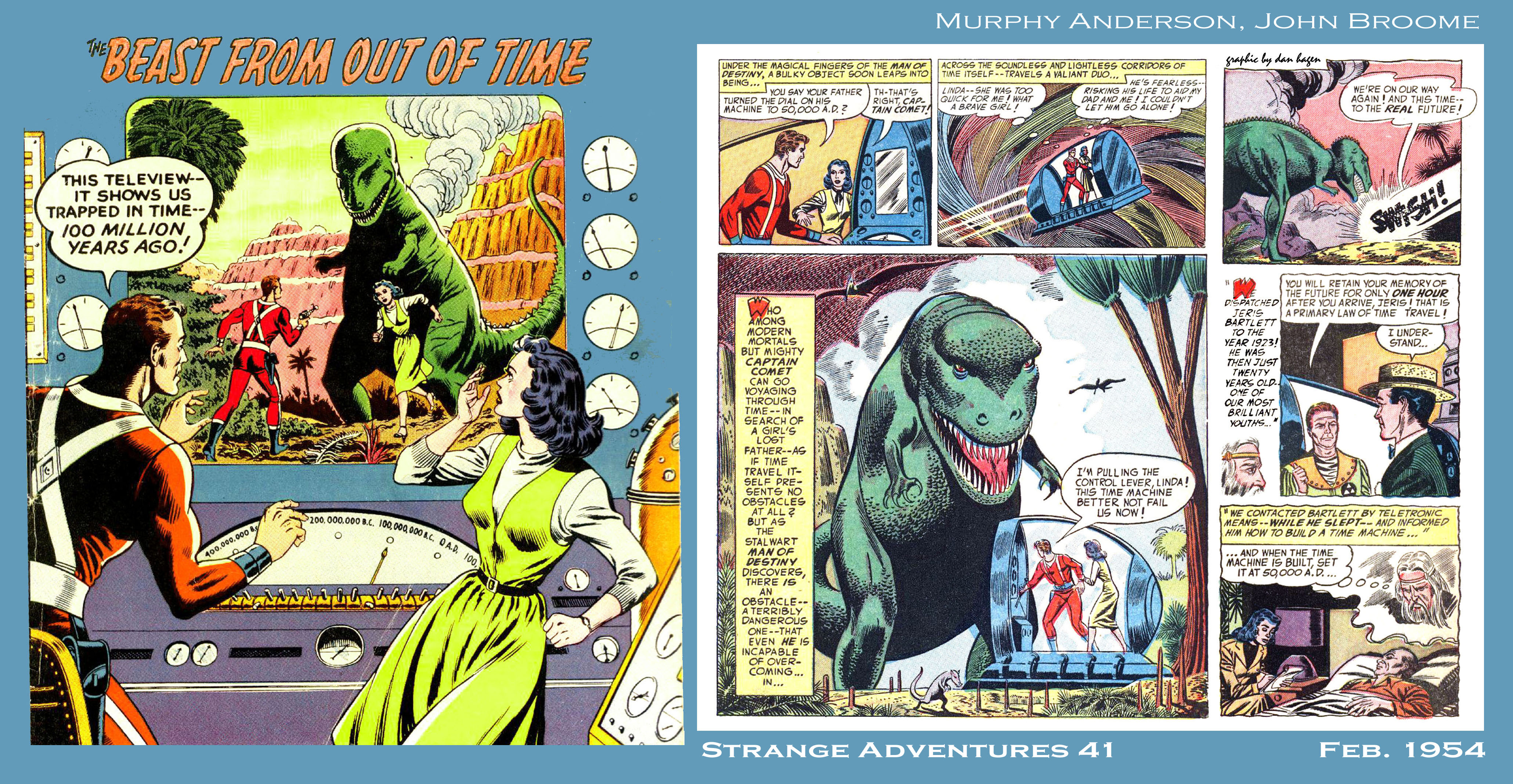
In Strange Adventures 41 (Feb. 1954), Captain Comet Dr. Whos his way from the Cretaceous to 50,000 A.D. in The Beast from Out of Time . The story begins when library information clerk Adam Blake gets a question he could easily answer, but doesn’t dare: where can Captain Comet be found? Linda Bartlett’s father, the nuclear physicist Jeris Bartlett, has mysteriously disappeared, and she doesn’t think the police will believe her bizarre story — but Captain Comet might. A meeting is quickly arranged, and Linda tells the mutant superhero that for years, her job was to sit beside her father as he slept and write down what he might say. She was a kind of hypnagogic stenographer. “Let me see what I was sleep-talking about last might,” Dr. Bartlett says one morning. “Hmm. Time travel! Isn’t it strange, Linda — that my unconscious mind should be so much more active than my conscious one” Working without food or rest, Dr. Bartlett completed his time machine, turned a dial to test i...

November 1953: Comet’s Cozy Catastrophe

Image
A classic science fiction story, The Day of the Triffids , gets a wink in Strange Adventures 38 (Nov. 1953). In John Wyndham’s 1951 novel, a freak meteor shower blinds most people on Earth, unleashing a plant menace and leading to the enslavement of the few remaining sighted people. DC’s science fiction stories often had a vibe similar to the “cozy catastrophe” novels for which Wyndham became famous. Whether the author was John Wyndham or John Broome, inexplicable and weird events would suddenly intrude on everyday reality, presaging some literally earthshaking menaces that would finally be resolved by cool-headed, rational professionals. For example, when everyone in a sleepy English village literally falls asleep, all the women become pregnant with super-powered alien babies in Wyndham’s 1957 novel The Midwich Cuckoos (filmed twice as Village of the Damned ). And fireballs falling from space into the worlds’ oceans herald the arrival of unseen undersea alien invaders in Wynd...

March 1953: The Gaslighters from Outer Space

Image
The shape-shifting aliens Obla-Gan and Ik-Kandor figure that if you can’t defeat a superhero by direct confrontation, maybe you can turn him against himself. Menace from the World of Make-Believe ( Strange Adventures 30, March 1953) begins with Captain Comet in his humdrum secret identity of librarian Adam Blake, when a boy asks to be read a fairy tale about giants. Blake’s occupation as a library information clerk reflected the reverence for knowledge that would be seen throughout DC’s Julius Schwartz-edited titles, with their scientist-heroes and Space Museums. Schwartz’s Silver Age super-heroes would include a police scientist, an archeologist, a test pilot, a physics professor and a museum director — all knowledge-based professionals. Ironically, whether they realized it or not, fans were seeing the future of super-hero comics here. Captain Comet was a protagonist poised precisely between the Golden and Silver Ages, but always looking ahead. The increasingly el...

December 1952: Double, Toil and Trouble

Image
In November, Captain Comet had encountered a female counterpart, Miss Universe. The next month saw him experiencing another superhero convention, at least as familiar as the distaff duplicate — the mirror-image enemy. The Man of Destiny faced his in The Counterfeit Captain Comet ( Strange Adventures 27, Dec. 1952). The story begins with one of writer John Broome’s intriguing everyday mysteries, the kind that lead to momentous events. Why is a newspaper ad seeking someone of Adam Blake’s exact physical measurements? As in the Sherlock Holmes adventure The Red-Headed League, the newspaper ad “search” has been staged to snare a particular target, in this case the superhero. Apparently his string of 17 victories against the forces of evil has made Captain Comet overconfident, because in this case he walks straight into what is pretty obviously a trap, without even using his mind-reading powers to find out what’s really going on. “Professor Z.D. Rin” — actually the alien agent ...

December 1951: Captain Comet Forgets Himself

Image
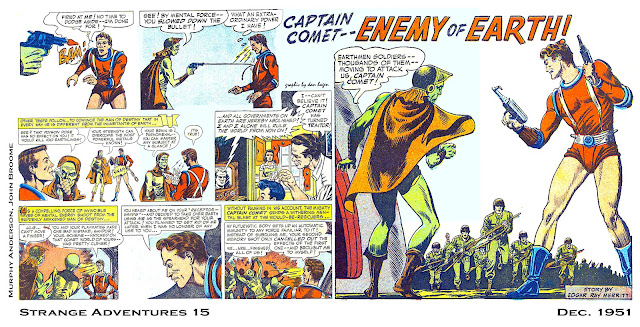
In Strange Adventures 15 (Dec. 1951), the tale Captain Comet—Enemy of Earth! uses Arthur Conan Doyle’s 1913 story The Poison Belt as inspiration, with the superhero filling in for Professor Edward Challenger. While trying to protect Earth from being poisoned by the gasses of a passing comet, the Man of Destiny is caught off guard by an amnesia ray, then told by the alien leader Sandor that he’s the “rightful ruler of Earth” and must help conquer it. Why? Sandor relies on the argument Magneto would later use — that humans will fear Captain Comet’s mutant super-powers and try to destroy him. The no-longer-good Captain cuts in on all television broadcasts (how many times would super-villains pull that trick?) to deliver a General Zod-like ultimatum about taking over the planet. Network television was only four years old in 1951, so this must have been one of the first uses of that melodramatic cliché. “The government will never accept such tyranny!” exclaims one man on the ...

December 1951: The Girl of Tomorrow

Image
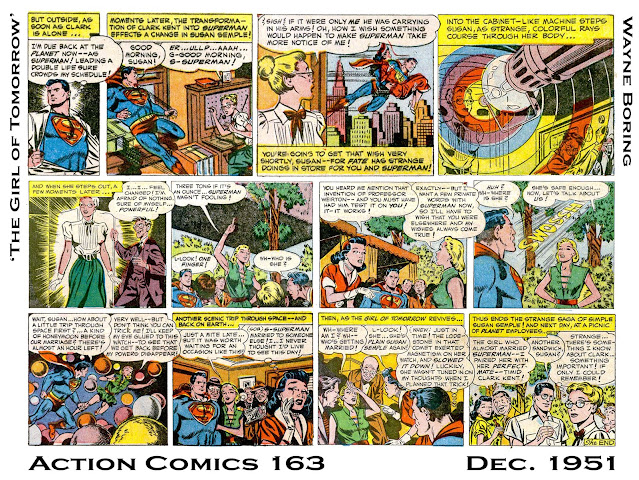
Superman encountered several super-females during his long career, including his own cousin and various amped-up versions of Lois Lane and Lana Lang. But Susan Semple was a variation on the theme. Unlike the others, this “Girl of Tomorrow” didn’t have powers that directly paralleled Superman’s. Introduced in Action Comics 163 (Dec. 1951), she appeared instead to be a female counterpart to Captain Comet, a DC character who’d been introduced in Strange Adventures seven months before. Captain Comet was, after all, himself a Superman updated from the 1930s to the 1950s, the era of the flying saucer and the atom bomb. His extraordinary abilities were more mental than physical. This new Man of Tomorrow’s powers included telepathy, telekinesis and ESP, and the Girl of Tomorrow shared them. Bespectacled Daily Planet receptionist Susan Semple mooned over Superman, and when she heard eccentric scientist Prof. Weirton’s claims that he could transform ordinary people into super beings, she was fi...

July 1951: Visions of Future Past

Image
Strange Adventures 10 finished Captain Comet's two-part origin and launched him on his first adventure. Captain Comet blazed the trail in a feature that looked much more like 1960 than 1940. The sleek elegance of Carmine Infantino’s art was emergent. It would be contemporary, clean-lined and sunlit, as optimistic and reassuring as the stories by John Broome. Infantino made the impossible seem pleasantly plausible, somehow putting the future within easy reach. “The mature Infantino drew everything — a hidden city of scientific gorillas, a harlequin committing crimes with toys, Flash strapped to a giant boomerang — as if he believed absolutely in its existence,” observed Gerard Jones and Will Jacobs in their excellent book The Comic Book Heroes. “But Infantino’s art could so fully evoke the quiet of a small-town afternoon or the cool of a shaded lawn that readers could forgive even plots full of beatniks, schoolteachers and singing idols.” The equally capable ...