Posts

Showing posts with the label H.G. Wells

July 1954: This Objective Earth

Image
Colonial imperialism is satirized in Interplanetary War Base! ( Strange Adventures 46, July 1954). With artist Gil Kane taking over for Murphy Anderson, the story begins with one of writer John Broome’s quotidian mysteries. Rancher Jeb Hawkins awakens to find that his clock-radio and his wristwatch have stopped at six minutes after three. So has his wife’s — and it’s still dark when it should be daylight. Meanwhile, while using the excuse of rearranging the Midwest City Public Library’s newspapers, information clerk Adam Blake actually reads them all within seconds and coordinates the information in his futuristic brain. Blake correlates an article about a western “black bubble” spotted by a pilot with another about a cattle buyer who was unable to find the Hawkins’ ranch despite having visited there before — and decides that Captain Comet had better look into this. Speeding west in the Cometeer, the Man of Destiny discovers a black dome that nullifies all electronic and ...
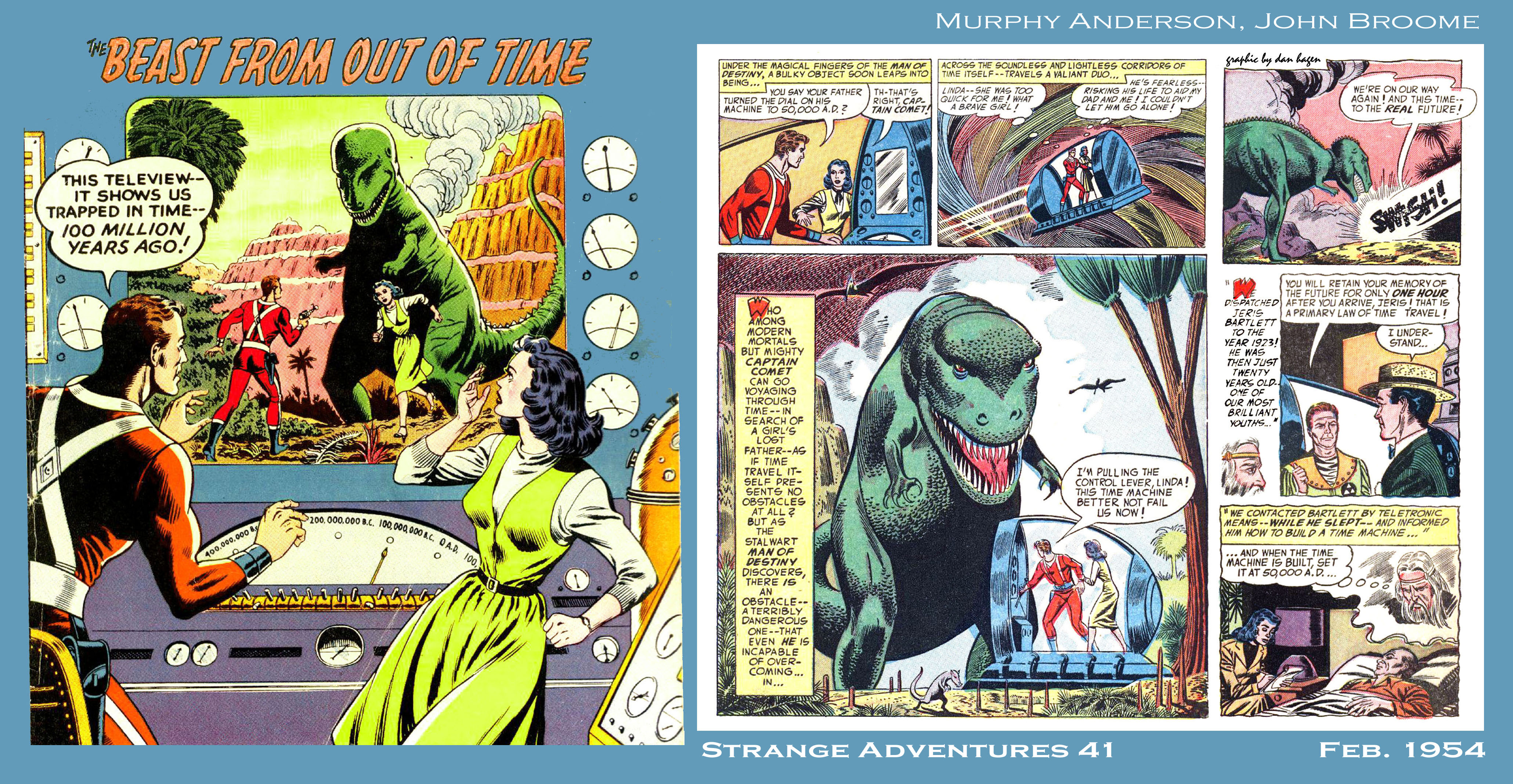
February 1954: All Our Tomorrows

Image
In Strange Adventures 41 (Feb. 1954), Captain Comet Dr. Whos his way from the Cretaceous to 50,000 A.D. in The Beast from Out of Time . The story begins when library information clerk Adam Blake gets a question he could easily answer, but doesn’t dare: where can Captain Comet be found? Linda Bartlett’s father, the nuclear physicist Jeris Bartlett, has mysteriously disappeared, and she doesn’t think the police will believe her bizarre story — but Captain Comet might. A meeting is quickly arranged, and Linda tells the mutant superhero that for years, her job was to sit beside her father as he slept and write down what he might say. She was a kind of hypnagogic stenographer. “Let me see what I was sleep-talking about last might,” Dr. Bartlett says one morning. “Hmm. Time travel! Isn’t it strange, Linda — that my unconscious mind should be so much more active than my conscious one” Working without food or rest, Dr. Bartlett completed his time machine, turned a dial to test i...

September 1953: Attack of the Arcade Aliens

Image
DC’s tendency to work children’s preoccupations into its stories is on display again in The Grab-Bag Planet ( Strange Adventures 36, Sept. 1953), when giant mechanical claws start grabbing up goodies on Earth as part of a treasure hunt played by bored, amoral aliens from the planet Cnossur. The reference is obviously to those glass-fronted arcade claw machines that offer tempting gimcrack prizes. They became popular in the early 20 th century, inspired by the public’s fascination with the steam shovels that excavated the Panama and Erie canals. “A hand crank on the front allowed them to make a descent into a pile of hard candy to grab a small prize,” noted Jake Rossen. “The wheel was sensitive: A wild spin could get the crane moving, while a light, radio-dial touch could zero in on a target.” “When the Great Depression hit, they became a cheap way to risk what little money people had for the chance at a child’s trinket — maybe even a dollar wrapped around a pocket knife… By t...

June 1953: Empire of the Bees

Image
Two H.G. Wells stories helped inspire Strange Adventures 33 (June 1953). In The Human Beehive , Adam Blake travels to an irradiated South Pacific island to find tiny mammals and gigantic insects, including a super-intelligent colony of bees that has apparently enslaved the tiny human islanders. “Captain Comet is always going on journeys to other places: often planets, here an island,” observed comics historian Michael E. Grost.   “(Writer John) Broome often liked his heroes to travel. We also learn here that Captain Comet is resistant to all forms of radiation, just like Broome's Atomic Knights to come. This story is crammed with small details and little plot ideas of all kinds. Although the Captain Comet tales are short, usually six pages, Broome tried to get as much story into them as possible.” The discovery of a monstrous minnow near a nuclear test site sends Captain Comet to the South Pacific. In fact, the U.S. had detonated its first hydrogen bomb at Eniwet...

April 1953: The Second War of the Worlds

Image
Instead of seeing nonexistent menaces that no one else can see, as he had in his last adventure, Captain Comet becomes the first person to recognize the actual threat that the nation is calmly watching on the newly popular medium of television. Already legendary in 1953, Orson Welles’ newscast-style radio adaptation of H.G. Wells’ 1897 novel War of the Worlds had sparked a national panic on Halloween in 1938. In Lights, Camera — Invasion! ( Strange Adventures 31, April 1953), a live teleplay of War of the Worlds is used as a cover for an actual alien invasion. “All over the nation people waited expectantly for Captain Comet’s first television appearance — in a coast-to-coast telecast of an interplanetary drama!” the story’s cover page announced. Live TV drama was common during the “Golden Age of Television” from 1947 to 1957. In fact, on Sept. 9, 1957, CBS’s Studio One aired The Night America Trembled , a top-rated television recreation of Orson Welles' radio broadcast ...

January 1953: The Cosmic Convicts

Image
Invisibility and flight are considered to be the top two fantasy super powers, and I’ve long been intrigued by any story that featured either. For example, the 1935 Doc Savage adventure The Spook Legion, featuring an invisible criminal gang, was the first that prompted me to part with the two quarters necessary to buy one of the Man of Bronze’s Bantam paperback reprints. The dramatic hook: how could a protagonist possibly overcome invisible enemies? In 1953, the Man of Destiny faced the same predicament. When a hydrogen bomb is stolen from a Pacific atoll during a test countdown, accredited observer Captain Comet traces the crime to invisible thieves from the planet Lamia in Devil’s Island in Space ( Strange Adventures 28, Jan. 1953). Devil’s Island, a penal colony in French Guiana, was notorious for its harsh treatment of prisoners. The island penitentiary operated from 1852 until the very year this issue of Strange Adventures was published. Turns out that the Septarch...