Posts

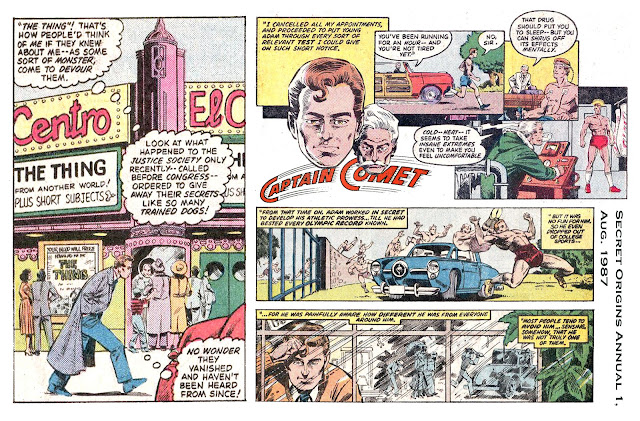
August 1987: The Secret Origin of Captain Comet
Image
  In 1951, when he debuted in Strange Adventures 9, Captain Comet was DC Comics’ new Jet Age version of the Depression-era Superman.  But 36 years later, by the time writer Roy Thomas retold his origin story in the first Secret Origins Annual, Comet seemed fairly old hat. However, an obstacle can sometimes be flipped over into an asset.  That very distance in time provided a perspective that Thomas used to advantage, positioning the story in overarching histories both real and fictional. So in addition to references to Reds, Rosenbergs and the Korean War, we’re entertained by this mutant Man of Tomorrow’s reflections on the recent fate of the Justice Society of America. Recalling how they were hounded into hiding by a McCarthy-era congressional committee, he grimly considers what that might mean to his own nascent career as a superhero in the gray flannel 1950s. “I was thrilled to see ‘Captain Comet’ appear so soon after All-Star Comics folded,” Thomas said, recalling ...

March 1986: When Men of Tomorrow Meet…

Image
Given that Captain Comet was a 1950s makeover of the 1930s Superman concept, emphasizing the mental more than the physical, it’s not surprising that the two might meet. But it was a long time coming — 29 years, in fact ( DC Comics Presents 22, June 1980). The Captain Comet feature’s emphasis on knowledge and science — or rather pseudo-science — was inevitable, given the world-shaking detonation of the atom bomb six years before. “Captain Comet was one of those superheroes created in the almost barren 1950s. J’onn J’onzz, Fighting American, and Captain Flash followed Captain Comet by a few years, and then the Flash led the revival,” observed Vincent Mariani. “All of these characters displayed new wrinkles on the superhero concept. “During the ’50s, there were so many genres being published that the superheroes were just part of a much more diverse business. The idea that superhero comics would ultimately completely dominate mainstream comics publishing was not imaginable to baby boomer...

August 1976: The Return of Captain Comet

Image
In 1976, Captain Comet took a leaf from another stalwart captain’s book, the one called America. Like that Marvel superhero, Adam Blake reappeared after having been missing for decades, apparently unaged. “He’s been across the galaxy twice aboard his Cometeer, visiting a thousand worlds with his flight belt, seeing sights no man has seen before him, or will ever see again,” wrote my old friend David Anthony Kraft, collaborating with Gerry Conway on the second issue of a fun title called The Secret Society of Super Villains (July-Aug. 1976). Pablo Marcos penciled. Out of touch in deep space for two decades, Comet couldn’t be expected to tell a superhero from a supervillain, so he waded into a skirmish against Green Lantern on the side of what he presumed to be underdogs, Grodd the Super Gorilla and the playing-card themed Hi-Jack. Actually, given his own past experience with evil super-gorillas and the fact that he’s telepathic, Captain Comet might have been a bit more suspicious. Whate...

August 1957: The Shadow of Captain Comet

Image
By 1957, comic book super powers were sometimes more subtle than those of the wall-smashing wonders who had started to appear in the late 1930s. Take for example the odd little gem The Future Mind of Roger Davis in Strange Adventures 83 (Aug. 1957), drawn by Gil Kane with a script by Ed Herron. Like the superheroic spaceman Captain Comet (whose run in Strange Adventures had ended three years earlier), Davis had the brain of someone evolved 100,000 years beyond his time. But he was no mutant like the earlier champion of justice. Instead, the winter sportsman Davis acquired his powers when the landing of an alien spacecraft spooked his horse and upset his sleigh, causing him brain damage. Yellow-skinned, nose-less, balloon-headed aliens repair Davis’ brain, and in doing so vastly improve it. The revived Davis thinks he can read the aliens’ minds, but one of them explains that he is mistaken, saying, “The ultra-perceptive area of the brain in your evolutionary stage of life has not yet ...

October 1954: Comet at Twilight

Image
In Captain Comet’s final adventure of the 1950s, the fictional futuristic man faces off against a symbol of society’s actual future — the computer. Or so it seems. In The Revolt of the Thinking Machine (Strange Adventures 49, Oct. 1954) , the Man of Destiny communicates the history of what he presciently says may be his “final battle” to Prof. Zackro through the professor’s TV. As newsboys shout that a Midwest University “thinking machine” has locked out the scientists who built it, Captain Comet tells Zackro, “I got to the Physics Building, of course, only moments after the story got out…” Communicating through a typewriter, the “giant calculator” warns, “No one must interfere with what I am doing! If anyone forces his way into the room, I shall destroy him!” The Man of 100,000 A.D. does just that as the machine blasts him with electric energy. “The bolts, of course, had no effect on me!” Comet tells Zackro. “My unique body instantly set up an immunity to the p...

July 1954: This Objective Earth

Image
Colonial imperialism is satirized in Interplanetary War Base! ( Strange Adventures 46, July 1954). With artist Gil Kane taking over for Murphy Anderson, the story begins with one of writer John Broome’s quotidian mysteries. Rancher Jeb Hawkins awakens to find that his clock-radio and his wristwatch have stopped at six minutes after three. So has his wife’s — and it’s still dark when it should be daylight. Meanwhile, while using the excuse of rearranging the Midwest City Public Library’s newspapers, information clerk Adam Blake actually reads them all within seconds and coordinates the information in his futuristic brain. Blake correlates an article about a western “black bubble” spotted by a pilot with another about a cattle buyer who was unable to find the Hawkins’ ranch despite having visited there before — and decides that Captain Comet had better look into this. Speeding west in the Cometeer, the Man of Destiny discovers a black dome that nullifies all electronic and ...

May 1954: Amid the Alien Corn

Image
A Cold War “enemy within” vibe continues in Strange Adventures 44 (May 1954), when evil, intelligent alien plants disguise themselves as terrestrial trees.   “Without detection, the aliens landed on Earth — threatening the very existence of humanity!” proclaims the splash-page narration. The trees that loom menacingly and grasp at Captain Comet and his companion Joyce Rollins look a good deal like the hostile anthropomorphic trees in 1939’s The Wizard of Oz — a film that CBS would begin airing annually two years later, on Nov. 3, 1956. The Plant That Plotted Murder provides another echo of John Wyndham and his 1951 novel The Day of the Triffids . The tale anticipates The Plant That Hated Humans ( Strange Adventures 150, March 1963). That Atomic Knights story — also by John Broome and Murphy Anderson — features telepathic, malevolent plants. Cold war fears involving alien plant life would be famously spotlighted in late 1954 with the serial publication of Jack Finney’s ...

April 1954: Thinking Outside the Boxer

Image
Captain Comet’s friend Prof. Zackro takes center stage as a stand-in for Arthur Conan Doyle’s Prof. George Edward Challenger in The Phantom Prize Fighter ( Strange Adventures 43, April 1954). Just as Challenger was mocked by London scientists for claiming to have found a “Lost World” of dinosaurs in Doyle’s 1912 novel of that name, Zackro faces rueful researchers who claim that Captain Comet’s alleged mutant telekinetic abilities are impossible. The Man of Destiny agrees to fight the heavyweight champion of the world to prove what he can do, but during the bout something happens that even Comet finds weird—the champ’s fist sails harmlessly right through him. Comet discovers that the anomaly was the result of an assassination attempt because a one-eyed, slug-like alien, disguised as an electrical technician, had tried to disperse his atomic structure. And once again, Captain Comet proved to be a precursor for the Silver Age. The cover image, of a prize fighter’s fist slipp...

March 1954: The Power of Childhood

Image
The sight of children at play startles stalwart Captain Comet in Strange Adventures 42 (March 1954). Why? The cover scene, repeated in the story, shows the Man of Destiny watching a costumed boy and girl playing at a Captain Comet adventure, and reminds me of a similarly charming scene in Fantastic Four 11 (Feb. 1963). Four children imitating the FF go from boisterous to awestruck when they’re treated to a good-natured demonstration of the real team’s super-powers. The Planet of Ancient Children is Comet’s inadvertent destination in Strange Adventures 42. The children playing remind him of the planet Glete, which is run by telepathically powered youngsters who age in reverse. “You must think I acted pretty strange back there with the kids,” Comet tells Prof. Zackro. “But you’ll understand when you’ve heard what I’m about to tell you…” During his first attempt at intergalactic flight in the Cometeer, the superhero’s ship was seized by a mysterious force and directed to Gle...

February 1954: All Our Tomorrows

Image
In Strange Adventures 41 (Feb. 1954), Captain Comet Dr. Whos his way from the Cretaceous to 50,000 A.D. in The Beast from Out of Time . The story begins when library information clerk Adam Blake gets a question he could easily answer, but doesn’t dare: where can Captain Comet be found? Linda Bartlett’s father, the nuclear physicist Jeris Bartlett, has mysteriously disappeared, and she doesn’t think the police will believe her bizarre story — but Captain Comet might. A meeting is quickly arranged, and Linda tells the mutant superhero that for years, her job was to sit beside her father as he slept and write down what he might say. She was a kind of hypnagogic stenographer. “Let me see what I was sleep-talking about last might,” Dr. Bartlett says one morning. “Hmm. Time travel! Isn’t it strange, Linda — that my unconscious mind should be so much more active than my conscious one” Working without food or rest, Dr. Bartlett completed his time machine, turned a dial to test i...

January 1954: The Spider Who Loved Me

Image
In Strange Adventures 40 (Jan. 1954), Captain Comet confronts yet another a beautiful mental marvel, this one a thief whose energy beams can paralyze bonded messengers. I say “yet another” because this menace, The Mind Monster, was the third psi-powered superwoman the Man of Destiny had run into since his debut in 1951. First came the 18-year-old mutant Radea, The Girl from the Diamond Planet, in Strange Adventures 12 (Sept. 1951). She was followed in Strange Adventures 26 (Nov. 1952) by Miss Universe, who turned out to a super-evolved plant being from a world that would someday occupy Earth’s position in space. That would probably have disqualified her from the first Miss Universe Pageant, actually held in Long Beach, California, earlier that same year. When the police backtrack The Mind Monster to Prof. Zackro’s lab, Comet discovers that she is in fact a spider who has been hyper-evolved by exposure to the concentrated radiation from a supernova the professor had been ob...

December 1953: Sinister Simian Strikes Again

Image
Captain Comet’s version of Grodd, the “diabolically intelligent” Man-Ape, returns as a criminal defendant in The Guilty Gorilla ( Strange Adventures 39, Dec. 1953). By telepathically controlling a judge and manhandling police officers like rag dolls, the simian is able to escape and recruit a criminal gang to help him. This super-gorilla, Comet’s only recurring archenemy, foreshadows the string of early appearances by Grodd in the Silver Age Flash title. DC’s over-reliance on gorilla covers would become an affectionately mocked cliché in the late 1950s and early 1960s. The trend started in Strange Adventures . “The eighth issue of Strange Adventures achieved some sort of cult status,” noted Greg Hyland. “The cover showed a gorilla in a zoo holding up a slate that read, ‘Please believe me! I am the victim of a terrible scientific experiment!’ This Incredible Story of an Ape with a Human Brain had strong sales, and [DC editor, Julius] Schwartz recalls that (publisher) ‘Irwin...

November 1953: Comet’s Cozy Catastrophe

Image
A classic science fiction story, The Day of the Triffids , gets a wink in Strange Adventures 38 (Nov. 1953). In John Wyndham’s 1951 novel, a freak meteor shower blinds most people on Earth, unleashing a plant menace and leading to the enslavement of the few remaining sighted people. DC’s science fiction stories often had a vibe similar to the “cozy catastrophe” novels for which Wyndham became famous. Whether the author was John Wyndham or John Broome, inexplicable and weird events would suddenly intrude on everyday reality, presaging some literally earthshaking menaces that would finally be resolved by cool-headed, rational professionals. For example, when everyone in a sleepy English village literally falls asleep, all the women become pregnant with super-powered alien babies in Wyndham’s 1957 novel The Midwich Cuckoos (filmed twice as Village of the Damned ). And fireballs falling from space into the worlds’ oceans herald the arrival of unseen undersea alien invaders in Wynd...