August 1957: The Shadow of Captain Comet

By 1957, comic book super powers were sometimes more subtle than those of the wall-smashing wonders who had started to appear in the late 1930s.
Take for example the odd little gem The Future Mind of Roger Davis in Strange Adventures 83 (Aug. 1957), drawn by Gil Kane with a script by Ed Herron.
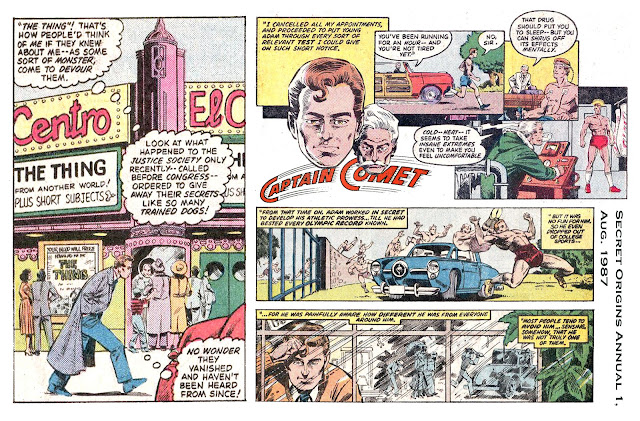
Like the superheroic spaceman Captain Comet (whose run in Strange Adventures had ended three years earlier), Davis had the brain of someone evolved 100,000 years beyond his time. But he was no mutant like the earlier champion of justice.
Instead, the winter sportsman Davis acquired his powers when the landing of an alien spacecraft spooked his horse and upset his sleigh, causing him brain damage. Yellow-skinned, nose-less, balloon-headed aliens repair Davis’ brain, and in doing so vastly improve it.

“It’s like having a sixth sense,” exclaims Davis.
“Whatever you call it, it was a life-saving necessity! It is our fervent wish that we have made amends for the trouble we’ve caused. And now, we depart. Farewell, Earthman!”
The usefulness of his newly acquired “ultra-perceptive brain” immediately becomes apparent.
Flagging down a truck on the icy road, Davis explains to the driver that a small flaw in his right rear tire is about to cause a blowout. The scornful driver proceeds — and his tire immediately fails.
The driver wonders how Davis could possibly have known that.
“Tires create friction — friction creates heat!” Davis replies. “Heat creates waves! I sensed a variation of heat waves from the tire indicating a thin, worn area, and…”
Suddenly realizing how that must sound, Davis continues: “Uh — just say that I once had a tire just like that, and I got a blowout! When I saw yours, I knew the same thing would happen!”
Davis’ subtle perceptive powers have an echo in real life. I suspect many of us of have had the experience of thinking someone else is deliberately ignoring the obvious, only to realize later that they actually can’t see what we see.
“I actually foresaw it! But how could I ever explain it to the driver?” Davis muses, as he gets a lift to a nearby mountain town.
His super power enables him to avoid being crushed by a falling boulder. Later, in his hotel room, Davis looks out the window at an ominous sight. He perceives that an impeding snowslide is going to bury the village.
The villagers scoff at Davis’ warning, but are finally convinced by the truck driver and agree to escape via cable car. Staying behind to operate the cable car mechanism, Davis is caught in the massive snowslide.
He awakens in the hospital, having survived his second round of brain surgery in a single day. Davis finds that his super powers are gone, but is unconcerned. He’s more interested in when he can go skiing again.
Having succeeded the super-evolved Captain Comet, Roger Davis also anticipated the 1966 origin of the Japanese Ultraman. Fatally injured in an accidental collusion with a spherical spaceship, Science Patrolman Hyata is saved when the 300-foot alien police officer Ultraman merges with him.

While superheroes per se were relatively scarce in 1950s comic books, protagonists who had super powers continued to turn up regularly — many of them in Strange Adventures.
In DC’s Strange Adventures 106 (July 1959), for example, the story Genie in the Flying Saucer! provides a protagonist who gains reality-bending mental powers from an alien visitor.
In Strange Adventures 119 (August 1960), a struggling stage magician accidentally acquires an alien’s super-technological wand-like device and its miraculous powers.
In Strange Adventures 124 (Jan. 1961), two South Dakota highway patrolmen are granted telepathic abilities when they team up with the giant orange Faceless Creature from Saturn.
In Strange Adventures 137 (Feb. 1962), an astronomy professor telepathically teams up with a green, dog-sized, ant-like alien — Ptandol from the exploded planet Fralimar — to save the Earth from a space vortex.
After the superhero heyday of the 1940s, super powers remained a staple of science fiction comics, with or without costumes attached.
In superhero comics, super powers were wish fulfillment. But in science fiction and fantasy comics, super powers could serve both as wish fulfillment and as cautionary tales about the dangers of power.



Comments
Post a Comment